Guide to Secure Choice Retirement Programs

Learn Your Alternatives
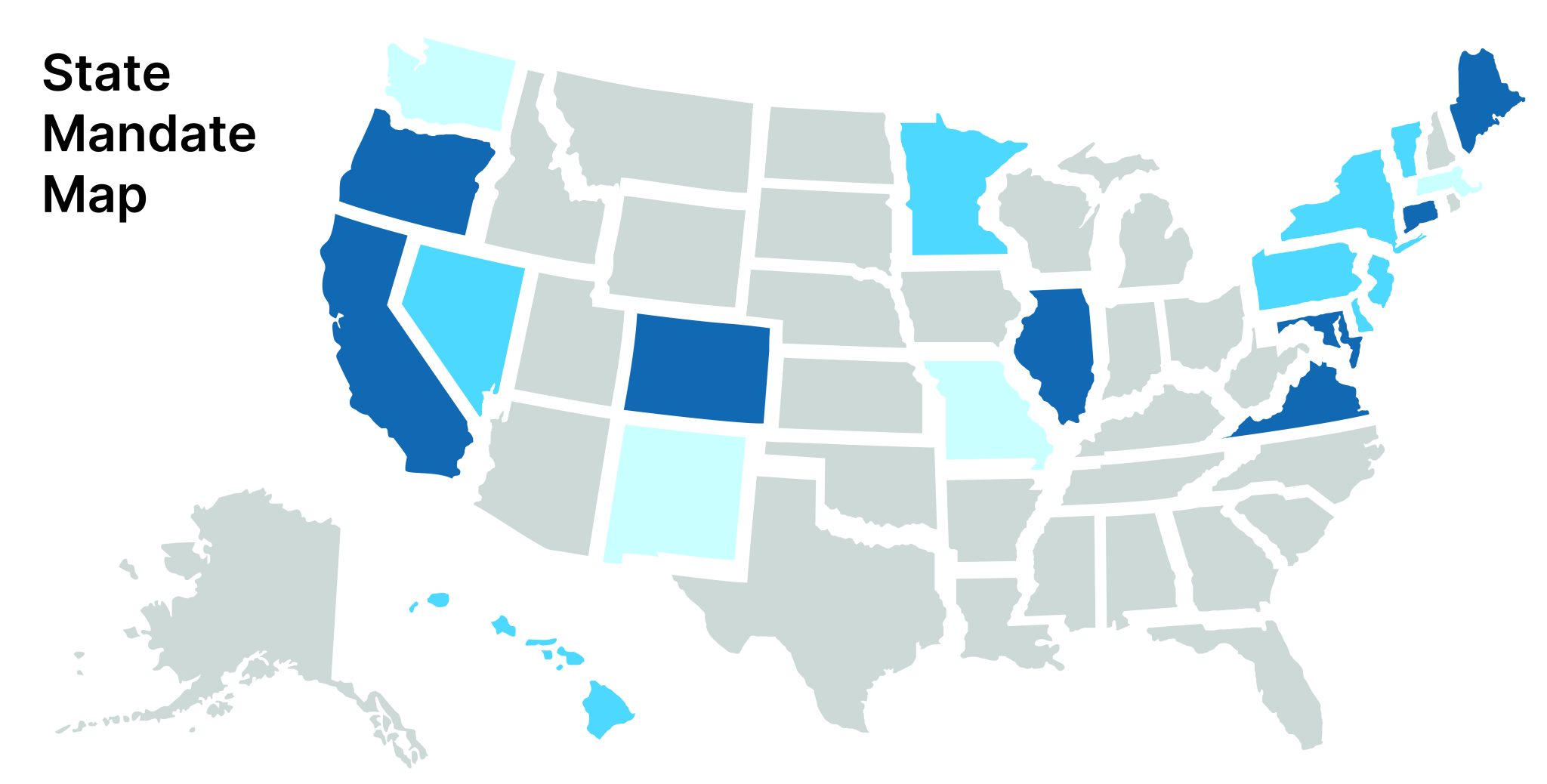
Washington
Currently offering a voluntary marketplace; will institue mandates like other states. Legislation signed, with a program to launch January 2027.
Oregon
Active plan, all deadlines passed. Penalties apply.
Nevada
Active plan, all deadlines passed.
California
Active plan, all deadlines passed. Penalties apply.
Colorado
Active plan, all deadlines have passed. Penalties apply.
New Mexico
Inactive.
Minnesota
Active plan. Deadlines: Soft launch and voluntary enrollment for any size covered employer Jan. 19, 2026 to March 30, 2026, 100 or more April 1, 2026 to June 30, 2026, 50 to 99 July 1, 2026 to Dec. 31, 2026, 25 to 49 Jan. 1, 2027 to June 30, 2027, 10 to 24 July 1, 2027 to Dec. 31, 2027, 5 to 9 Jan. 1, 2028 to June 30, 2028. Penalties apply.
Illinois
Active plan. Penalties apply.
Missouri
Not operational yet.
Pennsylvania
Pending legislation.
New York
Active plan. Deadlines: Employers with 10 or more employess that have been in business for at least 2 years. March 18, 2026, if they have 30 or more employees. May 15, 2026, if they have 15 to 29 employees. July 15, 2026, if they have 10 to 14 employees
Vermont
Active plan, all deadlines passed. Penalties apply.
Maine
Active plan. All deadlines passed. Penalties apply.
Connecticut
Active plan, add deadlines have passed. Penalties apply.
Massachusetts
Active, voluntary MEP for non-profits only.
New Jersey
Active plan, all deadlines passed. Penalties apply.
Delaware
Active plan. All deadlines passed. Penalties apply.
Maryland
Active plan. Deadline is December 31, every year.
Virginia
Active plan, all deadlines passed. Penalties apply.
Rhode Island
Active plan. Deadlines: Businesses employing more than 100 eligible employees must comply no later than October 15, 2026; Businesses employing between 50 and 99 eligible employees must comply no later than October 15, 2027; and Businesses employing between 5 and 49 eligible employees must comply no later than October 15, 2028. Penalties apply.
Hawaii
Legislation passed. Implementation TBD.

Download the free guide to secure choice retirement plans.
This guide will help you know what to consider when choosing a retirement benefit.
Your Peers Know the Story
Melissa M, Mid-Market Business Officer
Justin C, Small Business Owner
Jeffery L, Small Business Founder
Will C, Small Business Financial Advisor
Questions? We’ve Got Answers.
Is it legally required in all U.S. states for employers to provide retirement plans to employees?
In most states, employers are not required to offer retirement plans. However, a few states do have these requirements, and several more are working on legislation. See the list above for details.
What counts as an employer retirement plan?
Do employees like the state plans?
By contrast, 401GO has a 4.8-star rating and leads the industry for customer support.
Do employees have to participate in state plans?
What are the penalties for not offing a retirement plan?
From the team.
What’s actually changing in retirement infrastructure, the advisor channel, and the technology underneath it. Written by the people building it, not a content agency.



Start Your Journey with 401GO