TRADITIONAL IRA

Give your employees individual retirement access with ZERO added complexity.

A 401(k) covers your employees while they work for you. A Traditional IRA extends their retirement savings access beyond the workplace — and rounds out your benefits package with the kind of individual flexibility that today’s employees increasingly expect.

401GO’s Traditional IRA offering lets you bundle individual retirement access into your existing benefits stack. Employees open and contribute to their own IRA accounts, payroll-synced and platform-managed, without any additional administrative burden on your team.

How It Works

A Traditional IRA is an individual retirement account that an employee owns independently. Contributions are made with pre-tax dollars (subject to income limits), grow tax-deferred, and are taxed as ordinary income at withdrawal. Unlike a 401(k), the IRA belongs to the employee — not to the plan — which means it travels with them regardless of where they work.

The employer role

Through 401GO, you make the IRA offering available to your employees as part of your benefits package — and payroll integration handles contribution processing automatically. You’re not administering individual accounts. You’re simply making the option available through a platform that handles the rest.

The employee role

Employees open their own IRA account, choose their contribution level, and manage their investments. Contributions are deducted from payroll automatically. In 2026, employees can contribute up to $7,500 per year ($8,500 for those 50 or older).

Deductibility

Traditional IRA contributions may be fully or partially deductible depending on the employee’s income and whether they (or their spouse) participate in an employer-sponsored retirement plan. 401GO provides educational resources to help employees understand their individual situation — the deductibility question is one of the most common sources of confusion.

The IRA as a Rollover Destination

When an employee leaves your company, they have options for their 401(k) balance: leave it in the plan, roll it into a new employer’s plan, or roll it into an IRA. A Traditional IRA rollover allows the employee to maintain tax-deferred growth without being tied to any employer’s plan.
For advisors using 401GO, participant wealth visibility in the platform means you can see when an employee terminates — and be positioned to facilitate the rollover before the assets go elsewhere. The IRA infrastructure is already in place.

The best time to explain rollover options to an employee is before they leave, not after. An IRA offering makes that conversation natural.

Traditional IRA vs. Roth IRA: The Quick Version

Both are individual retirement accounts with similar annual contribution limits. The key difference is tax timing: Traditional IRA contributions are potentially tax-deductible now, and withdrawals in retirement are taxed as income. Roth IRA contributions are made after-tax, and qualified withdrawals in retirement are tax-free.
401GO’s IRA offering is focused on the Traditional IRA. Employees who want Roth IRA access can open one independently at any financial institution alongside their employer-facilitated Traditional IRA.
FREQUENTLY ASKED QUESTIONS

Questions? We’ve Got Answers.

Honest answers about how the platform works, what it costs, and where it fits.
Can employees have both a 401(k) and a traditional IRA?

Yes. 401(k) and IRA contribution limits are separate. Employees can contribute the maximum to both in the same year. In 2026, that’s $24,500 to the 401(k) plus up to $7,500 to the IRA — a combined potential of $32,000 in tax-advantaged retirement savings per year. The IRA deductibility may be limited depending on income.

Anyone with earned income can contribute to a Traditional IRA — there are no income limits for contributions. However, the deductibility of those contributions phases out at certain income levels for participants who are also covered by a workplace retirement plan. The phase-out range for 2026 is $79,000–$89,000 for single filers and $126,000–$146,000 for married filing jointly when covered by an employer plan.
The IRA is the employee’s account — it belongs to them, not to the plan or the company. When they leave, the account simply stays with them. They can continue contributing independently, roll over their 401(k) into it, or consolidate other retirement accounts into it. No action required on your end.
The payroll-facilitated IRA offering through 401GO is structured to minimize employer compliance burden. Employees own their accounts individually. The employer’s role is limited to facilitating payroll deductions and making the benefit available — 401GO handles the administrative infrastructure.
Two reasons. First, it rounds out the retirement benefits package — some employees prefer the flexibility and portability of an IRA over a 401(k). Second, it creates a natural rollover destination when employees leave, which keeps assets within the 401GO ecosystem and, for advisors using the platform, maintains the advisor-participant relationship.

Not the right fit?
Explore the full 401GO portfolio.

401GO offers a full range of retirement plan types. If you’re not sure where to start, our team will help you find the right structure for your business size, goals, and budget.

Safe Harbor 401(k)

simplified compliance for employers who want it

Starter 401(k)

for businesses just getting started

Solo 401(k)

for owner-only businesses

ERISA 403(b)

purpose-built for tax-exempt organizations

Traditional IRA

individual retirement access

Cash Balance

for businesses with more complex planning needs

FUTURES BUILT HERE

A complete retirement benefits package in one easy platform.
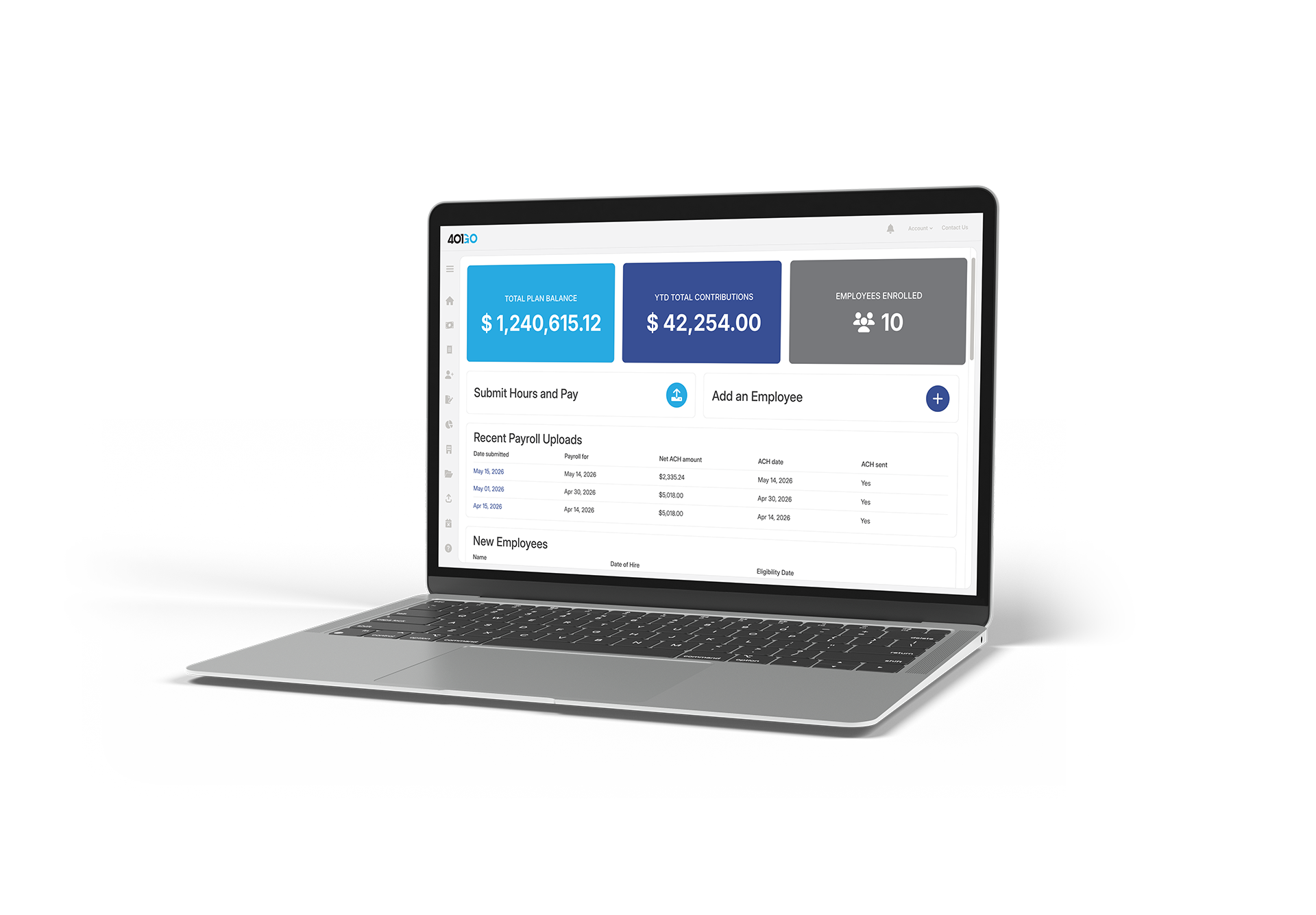
The 401(k) covers your team at work. The IRA covers them wherever their career takes them next. Together, they make your retirement benefits package one fewer reason for a great employee to leave.